As April–May approaches, the Annual General Body Meeting (AGM) is something viewed with deep anxiety by individuals managing accounts in thousands of churches, temples, sports clubs, residents' associations, and charitable trusts that follow manual accounting.
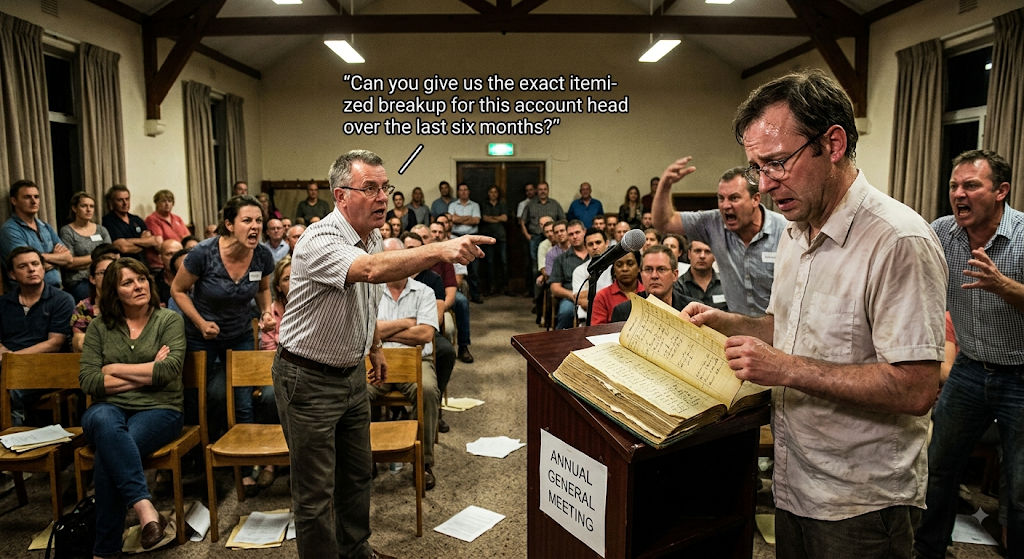
Picture this scene: The hall is packed with people. The treasurer stands on the stage holding a thick, worn-out ledger book. After the introductory speech, he reads out a summary of the income and expenditure statement he prepared. Following that, the discussion on it begins. Suddenly, a member stands up, points to a lump-sum figure under the head "Event Expenses," and asks:
"Can you give us the itemised breakup for this account head over the last six months?"
Silence. The Treasurer begins flipping through page after page of the handwritten Day Book — each entry recorded chronologically, with no way to quickly pull up a ledger view for a specific account head. Minutes pass. Sweat forms. Members begin to whisper. Trust, built over years, begins to crack — not because the accounts are dishonest, but simply because the system cannot answer the question.
This scene plays out in hundreds of organisations every year. And the tragedy is that it is entirely avoidable.
The Audit Problem: When Manual Books Are Not Enough
If a tense general body meeting is uncomfortable, an external audit conducted on handwritten registers is something else entirely.
Compliance requirements have tightened significantly in recent years. Nearly every registered association, trust, and organisation now faces mandatory external auditing. And the first things a modern auditor asks for are not handwritten ledgers — they are:
What Auditors Ask For
- Clean, structured, printable reports — Summary of Accounts, Cash Book, Account Head-wise Ledger
- Soft copies in Excel format for quick cross-verification and data matching
- A traceable audit trail with no unexplained gaps or corrections
You cannot hand an auditor a stack of handwritten registers and expect them to transcribe it. Manual systems leave organisations exposed to accounting errors, misplaced vouchers, untraceable miscalculations, and — in the worst cases — qualified audit reports or regulatory penalties.
Take Back Control with Secure Ledger
It was to solve these exact, real-world problems that Secure Ledger was built — a complete offline accounting system grounded in double-entry bookkeeping principles, designed specifically for non-profits, churches, clubs, and small organisations that need professional financial management without cloud dependencies, monthly subscriptions, or data privacy risks.
1. Complete Financial Clarity at a Glance
The moment you open Secure Ledger, the dashboard gives you exactly what you need: real-time totals of Income, Expenses, and Net Balance. No more flipping through pages or reaching for a calculator. Whether a board member asks a casual question or an AGM is in full session, the Treasurer is always prepared.
2. Audit-Ready Reports in Seconds
Need a ledger breakup for a specific account head? One click. Need to send your auditor a structured Excel file? Done in moments. Secure Ledger generates the Cash Book, Account Head-wise Ledger, Summary of Accounts, Member Statements, and Regional Summaries — all formatted for print or export.
3. Works on Your Phone, Your PC, or Both
Your financial data belongs to your organisation — not a remote server. Secure Ledger runs 100% offline. There are no internet dependencies, no cloud fees, and no risk of a data breach from a third-party server. The app installs on Windows PC and Android phones or tablets, and data can be transferred between devices via a simple Excel backup.
4. One-Click Backup — Never Lose a Record
A single click exports your complete financial database to a structured Excel workbook. Store it on a USB drive, Google Drive, or your PC. If your device is ever lost or replaced, restoring every record takes minutes — not days.
Affordable by Design — A Deliberate Choice
Most established accounting software comes with steep annual subscriptions, expensive per-user pricing, or high upfront costs that are simply out of reach for small, community-driven organisations. So why is Secure Ledger priced the way it is?
The answer is straightforward: Secure Ledger was built to serve organisations that have long deserved better — not to maximise revenue.
For decades, churches, temples, resident associations, clubs, and NGOs across Kerala have maintained their accounts by hand — not by choice, but because professional software was priced far beyond their means. A comparable custom-built accounting system a decade ago would cost ₹30,000 or more to develop for a single organisation. Today, advances in development tools and streamlined workflows have made it possible to build better, multi-device capable software at a fraction of that cost — and those savings are passed directly to you.
Secure Ledger is priced as a one-time lifetime payment. No annual renewals. No hidden fees. No subscription creep.
Try It Before You Spend a Rupee
Every copy of Secure Ledger comes pre-loaded with a complete sample database — a fictitious Kerala parish with months of transactions already entered. You can explore every feature, generate every report, test the Excel export, and get completely familiar with the system before your organisation commits to anything.
Only when you are ready to enter your own organisation's data does a one-time license key become necessary. Until then, everything is free to explore.
Ready to Step Out of the Paper Era?
Download Secure Ledger for Windows PC or Android — free, with full sample data included. A license key is only needed when you switch to your organisation's live accounts.